

How to close the inner loop without letting anything fall through the gaps
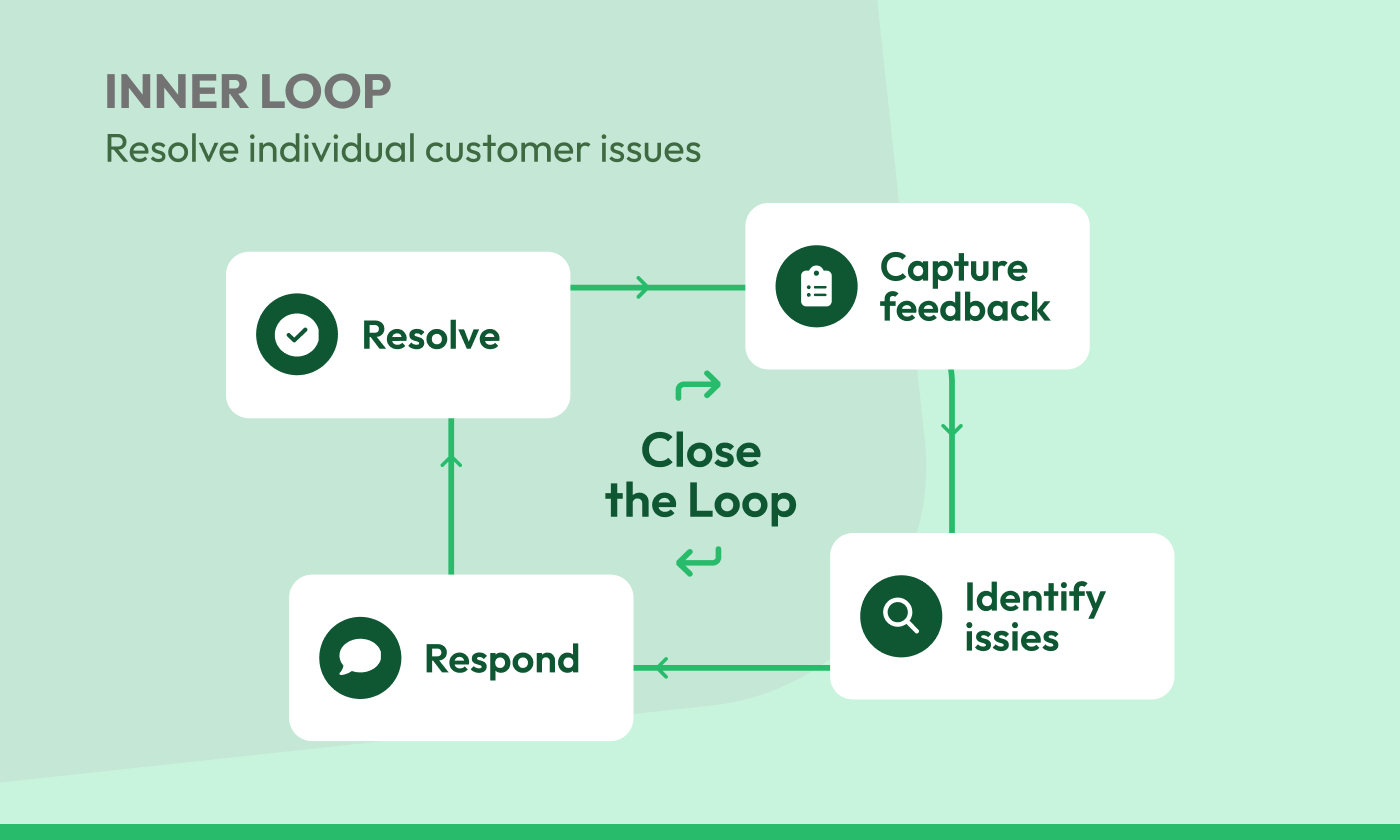
CX teams do not close the inner loop on their own. They cannot. A billing complaint gets resolved by the finance team. A delivery issue gets fixed by logistics. A product fault sits with operations. A technical problem needs IT. The CX team captures the feedback, manages the process, and is accountable for the outcome. But the person who actually resolves the issue almost never works in CX.
That is not a failure. It is just how organisations work. The question is not how to change it. It is how to build a process and a set of workflows that routes the right cases to the right people, in the tools they already use, quickly enough and reliably enough that nothing gets missed. That is an automation and systems problem as much as it is a CX one. And it is where the inner loop most often breaks down.
Key takeaways
- CX teams manage the inner loop process, but resolution depends on other functions. The workflow has to work for those teams too
- Manual routing and triage does not scale. Automation is what makes inner loop resolution consistent across every case, every channel, every day
- In regulated sectors, resolution within defined timelines with a full audit trail is a compliance requirement, not just best practice
- Whether you integrate with existing tooling or use a built-in case management solution, the goal is the same: every case that needs action gets actioned, by the right person, in the right system
CX owns the process. Other teams own the resolution.
This is the structural reality of inner loop management that does not get talked about enough. CX teams are accountable for closing the loop, but the actions required to actually close it sit across the business.
A customer flags a problem with their onboarding. That needs the customer success or implementation team. A resident raises a repair complaint. That goes to the property management or maintenance function. A patient reports a poor discharge experience. That involves clinical, administrative, or ward staff. In each case, the CX team's role is to make sure the right person knows about it, has what they need to act, and follows through to a documented resolution.
The challenge is not that other teams are unwilling to act. In most organisations, when the right person receives a clear case with full context, they deal with it. The problem is getting the case to that person quickly, in a format they can work with, without creating a process that relies on the CX team manually forwarding information, chasing updates, and logging outcomes.
When that manual layer exists, two things happen. Cases get delayed because they are waiting on a human to pass them on. And cases fall through because the handoff did not happen, the email was missed, or the spreadsheet did not get updated. Neither of those is a CX team failing. Both of them are process failures that automation is designed to prevent.
The inner loop works when the process is built around the people who do the resolving, not just the people who manage the programme. That means getting cases to other functions in the systems they already work in, with the context they need attached, and with visibility for the CX team to track progress without having to ask.
Why resolution matters more than acknowledgement
There is a version of inner loop management that looks like it is working but is not. A response comes in. An automated acknowledgement goes out. A ticket gets opened. And then it sits.
Acknowledgement is not resolution. A customer who receives a 'we have received your feedback' message and then hears nothing is not a closed loop. They are a customer who now knows their feedback went nowhere. That experience is often worse than receiving no response at all, because it raises an expectation and then fails to meet it.
Genuine resolution means the issue was investigated, action was taken, and the customer was told what happened. That is the interaction that changes retention behaviour. Research from Bain and Company shows that customers whose issues are resolved quickly are significantly more likely to stay than those who receive no follow-up. The follow-up is not a courtesy. It is a commercial lever.
The practical implication is that inner loop performance needs to be measured at the resolution stage, not the acknowledgement stage. How many cases were opened? How many were genuinely resolved? What was the average time from response to resolution? Those are the numbers that tell you whether the inner loop is working.
When resolution is not optional: regulatory requirements
For a significant number of CX teams, closing the inner loop within defined timelines is a compliance obligation. And the audit trail that proves it happened is not a nice-to-have. It is the evidence that demonstrates compliance when a regulator asks.
Social housing is probably the most demanding environment for inner loop compliance. The Housing Ombudsman's Complaint Handling Code sets out clear timelines for acknowledgement and response. Awaab's Law means certain complaint types, damp and mould being the most prominent, carry statutory response windows that are non-negotiable. Tenant Satisfaction Measures are published and scrutinised by the Regulator, so complaint handling performance is visible externally in a way it has never been before. For housing CX teams, a reliable inner loop is not a nice-to-have. It is what keeps the organisation on the right side of its obligations.
The FCA's complaint handling rules require financial services firms to resolve complaints promptly and keep complainants informed of progress. Firms are also expected to analyse complaint data to identify root causes, connecting the inner loop directly to the outer loop.
NHS Complaints Regulations require healthcare providers to acknowledge complaints quickly, investigate thoroughly, and demonstrate that learning was applied.
What these frameworks share is a requirement to prove the process, not just complete it. That means documented timelines, named ownership, records of communication, and a clear resolution outcome. A process that runs through inboxes, shared drives, and manually updated spreadsheets struggles to produce that evidence quickly or cleanly. A structured workflow does.
This is also where the cross-functional routing problem becomes acute. A complaint about a repair in social housing has to reach the maintenance team, be actioned, and come back with a resolution, all within a regulatory window. That chain of handoffs needs to be tracked and timestamped automatically. If any link in it relies on someone manually forwarding an email, the risk of missing the deadline sits with the whole process, not just with one team.
Why automation is what makes it consistent
Manual case management does not scale and it does not route reliably. A CX team that is reviewing every response, deciding what needs action, forwarding cases to other functions, and chasing updates by email is creating risk at every step. The cases most likely to get missed are exactly the ones that matter most: the ones that arrive at high volume, arrive outside office hours, or need to reach a team that is not physically close to the CX function.
Automation removes those risks by making the process rules-based rather than judgement-based. A response comes in and rules fire immediately. Does this response meet the threshold for a case? Yes. Who owns this type of case? The relevant team. What system do they work in? Route it there. What does the customer receive? An acknowledgement goes out now.
None of that requires a human to review the response first. And because the same rules apply to every response, the process is consistent regardless of volume, timing, or who is working that day.
The criteria that trigger automation can be configured to match how the organisation actually works. A score below a defined threshold. Negative sentiment detected in the open-text. A keyword or theme that maps to a specific team's remit. A customer in a segment or account tier that warrants a faster response. A response that mentions a regulated topic, a damp complaint in a housing context, a safeguarding concern in a healthcare one, that requires a specific workflow regardless of score.
Each trigger can route to a different team, create a different type of case, and generate a different acknowledgement. The logic is set once and then runs without intervention. That is what makes it possible to manage the inner loop across a large organisation where the people doing the resolving are spread across multiple teams, locations, and systems.
Two ways to route cases to the people who resolve them
The right approach depends on the tooling already in place across the organisation. Both paths deliver the same outcome: the right case reaches the right person, in the right system, with the right context, automatically.
Integrating with your existing tech stack
In most organisations, the teams responsible for resolving customer issues already have their own tools. The contact centre uses a helpdesk platform. Account managers work in a CRM. The maintenance team has a job management system. The billing team has its own workflow. Asking those teams to log into a separate feedback platform to pick up cases creates friction that slows resolution and reduces the chance that cases get actioned at all.
The better approach is to bring the case to the tool the team already uses. When a response meets the criteria for a case, it is created automatically in the relevant system with the customer verbatim, their score, their contact history, and any relevant context attached. The team member gets a notification in the platform they are already working in. No new login. No separate queue to check. The case arrives in the same place their other work arrives.
This is what makes cross-functional routing practical at scale. A CX team cannot chase every case across every function. But if cases are landing automatically in the right systems with the right information, the people doing the resolving can act without waiting to be briefed. And the CX team can track progress without having to ask, because the status is visible from the feedback platform through the integration.
Webhooks and APIs make this kind of integration achievable without significant technical overhead. Triggers are configured to match the routing logic the organisation needs. The data that flows through is shaped to fit the fields and workflows of the receiving system. Once it is set up, it runs.
Using a built-in case management solution
Where existing tooling is fragmented, absent, or not set up to handle customer complaint workflows, a built-in case management solution gives everyone a single system to work from. One place where cases are created, assigned, tracked, and closed. One place where the CX team has visibility of everything that is open. One place where the audit trail is built automatically.
The built-in approach works particularly well where the organisation is still developing its case management process, where teams are small enough that a shared platform is practical, or where the regulatory requirements make a unified audit trail important. Rather than trying to stitch together a paper trail across multiple systems, every action sits in one record from the moment a case opens to the moment it closes.
Cases are created automatically when a response meets the defined criteria. An owner is assigned based on the case type or routing rules. An acknowledgement goes to the customer immediately. The owner has everything they need in one place: the verbatim, the score, the customer history, and any previous cases from the same contact. They log their actions, update the status, and close the case with a documented outcome.
For teams with regulatory obligations, the audit trail this produces is straightforward to export and present. Every status change is timestamped. Every communication is logged. The resolution outcome is recorded against the original response. If a regulator asks how a particular complaint was handled, the answer is a single record, not a reconstruction from memory and email threads.
A built-in tool also makes it easier to bring other functions into the process without requiring them to adopt new tooling themselves. Cases can be assigned to staff across departments who access them through a simple interface, without needing to understand the broader feedback platform. The CX team manages the workflow. Other teams action the cases. The platform holds the record.
What a reliable inner loop looks like in practice
The mechanics look different depending on which approach you take, but the outcome is the same.
A response comes in and meets the criteria for action. A case is created automatically, routed to the right team, and the customer receives an acknowledgement within minutes. No one had to review it first. No one had to decide where it should go.
The person responsible for resolution has everything they need in the system they already use. They do not need to log in somewhere else, contact the CX team for context, or figure out what the case is about. They act on it.
The CX team can see the status of every open case without chasing anyone. Cases approaching a deadline surface automatically. Escalation rules fire if a case goes too long without a status update. Nothing expires without someone knowing about it.
The case closes with a documented outcome. What the issue was, what was done, and whether the customer confirmed they were satisfied. That record feeds back into the analysis layer, where patterns across closed cases contribute to the root cause identification that drives the outer loop.
How SmartCX supports inner loop resolution
SmartCX is built to work the way organisations actually work, where CX teams manage the process and other functions own the resolution. Both inner loop approaches are supported, with the same emphasis on automation, routing, and audit trail.
Integrating with your existing tech stack
SmartCX connects directly to Salesforce, HubSpot, and other platforms via webhooks and API. When a response meets your defined criteria, a case is created automatically in the relevant system with the full customer context attached. Triggers and alerts are configured around score, sentiment, theme, or customer segment, so routing logic reflects how your organisation actually handles different case types. The teams doing the resolving work in their own tools. The CX team tracks progress without leaving SmartCX.
Built-in case management
For teams that need a single system across functions, SmartCX's built-in case management handles the full workflow. Cases are created automatically, owners are assigned, acknowledgements are triggered, and every action is logged and timestamped from open to close. Deadline alerts and escalation rules mean regulated timelines are managed without manual monitoring. The audit trail is built into the process, not reconstructed after the fact. And because it sits within the same platform as feedback collection and analytics, resolved case data flows directly into the outer loop analysis.
See how SmartCX handles inner loop routing and resolution
Whether you need to integrate with an existing tech stack or build a case management workflow from scratch, we can show you how other CX teams have set it up. Book a 30-minute call and we will walk you through the options.
Frequently asked questions
If CX teams do not own the resolution, how do they stay accountable for it?
By owning the process rather than the outcome. The CX team's job is to make sure every case that needs action gets routed to the right person with the right information, that timelines are tracked, and that nothing closes without a documented resolution. They do not need to do the fixing. They need to build and manage the workflow that makes sure the fixing happens. That is where automation earns its value: it removes the manual steps that create gaps between the CX team raising a case and the right function resolving it.
What is the difference between acknowledging feedback and closing the inner loop?
Acknowledgement tells a customer their response was received. Closing the inner loop means the issue behind it was investigated, action was taken, and the customer was told what happened. A lot of programmes measure response rates and treat acknowledgement as the end point. The metric that actually reflects inner loop performance is resolution rate: how many cases were opened, and how many reached a documented outcome.
Which regulators require complaint resolution timelines and audit trails?
In the UK, social housing landlords operate under some of the most prescriptive complaint handling requirements around. The Housing Ombudsman's Complaint Handling Code, Awaab's Law, and Tenant Satisfaction Measures together mean that resolution timelines, audit trails, and complaint handling performance are all subject to external scrutiny. The FCA sets complaint handling requirements for financial services firms. NHS Complaints Regulations govern healthcare providers. The specifics differ, but the common thread is the same: you need to be able to prove complaints were handled properly, not just that they were received.
Do I need a separate case management tool if I already use a CRM?
Not if your CRM can be integrated with your feedback platform. The most practical approach for teams with an existing CRM is to connect the two so cases are created automatically in the system the relevant team already uses, with feedback context attached. Where CRM workflows are not set up to handle complaint-style cases, or where cases need to route across multiple teams each using different tools, a built-in case management solution is often cleaner.
How do automated triggers work for inner loop routing?
A trigger fires when a response meets defined criteria: a score below a threshold, negative sentiment in the open-text, a keyword or theme that maps to a specific team, or a combination of factors. When criteria are met, the trigger creates a case, assigns it to the right owner or team, sends an acknowledgement to the customer, and notifies the relevant person, all without manual intervention. Different criteria can route to different teams, create different case types, and generate different acknowledgements.
Ready to stop things falling through the gaps?
SmartCX gives CX teams the automation, routing, and case management they need to close every case that matters, whether that is through the tools your teams already use or through a built-in workflow that brings everything into one place. Book a 30-minute call to see how it works for your programme.


Alex is a growth marketing leader who has led digital transformation through AI and technology across multiple organisations. With experience across SaaS and the customer experience space, he knows what it takes to turn technology into business impact. Alex shares knowledge on feedback collection, text analysis and feedback management, helping organisations get more value from their feedback programmes.
See SmartSurvey in action


