

Collecting guest feedback at every stage of the journey (without survey fatigue)
.png)
Key highlights
Guests and passengers form opinions long before they arrive and long after they leave. But most travel and hospitality organisations only collect feedback at one point: after the experience is over. That single snapshot misses the booking, the arrival, the experience itself, and everything in between. The result is a partial picture that makes it hard to know where to improve.
What you'll learn in this post:
- Why post-experience surveys alone give you an incomplete and often misleading picture of satisfaction
- A six-stage journey framework that applies across hotels, airlines, train operators, attractions, restaurants, and other travel businesses
- How the same framework adapts to long experiences (multi-night stays, cruises) and short ones (flights, meals, day visits)
- What to ask at each stage, which channel to use, and which metric fits best
- How to use triggers and automation to collect feedback without manual effort
- How to avoid survey fatigue while still covering the full journey
The problem with post-experience-only feedback
If you only ask guests how their experience was after it's over, you're relying on a single data point to represent something that may have unfolded over hours, days, or weeks. And that data point is shaped by a well-documented psychological pattern: people disproportionately remember how the experience ended and how they felt at peak moments (positive or negative). Everything in between tends to blur.
This means collecting data via a post-experience survey without other touchpoint easily masks problems. Let's look at 3 examples to illustrate this further....
A hotel guest who struggled with the booking process, waited too long at check-in, and had a maintenance issue on the first night might still rate the stay positively if the final two nights were excellent and checkout was smooth.
An airline passenger who found the booking confusing and the check-in process stressful might score the flight well because the cabin crew were outstanding.
A visitor who queued for 40 minutes at the entrance to a theme park might forget that frustration entirely after a brilliant day inside.
Capturing post-experience in isolation gives you a score that looks fine, but fixable problems went undetected that also have the potential to snowball into negative experiences.
The reverse is also true. A guest who had a wonderful experience but a frustrating departure (a billing error, a delayed bag, a rude interaction at the gate, a long wait for the bill) may give a low score that doesn't reflect the overall experience. You end up fixing the wrong things.
Collecting feedback at multiple stages gives you a more accurate, more actionable picture. Each stage tells you something different, and together they reveal patterns that a single survey never could.
A universal framework: six stages, many journeys
Travel and hospitality is not one industry. A boutique hotel, a budget airline, a national rail operator, a cruise line, a theme park, and a restaurant chain all deliver fundamentally different experiences. A five-night resort stay has almost nothing in common with a 90-minute train journey on the surface.
But despite those differences, most travel and hospitality experiences follow a broadly similar shape with six stages. The details change significantly, the duration of each stage varies, and some stages may be more or less relevant depending on your business, but the framework applies. Here are the six stages where feedback is most valuable.
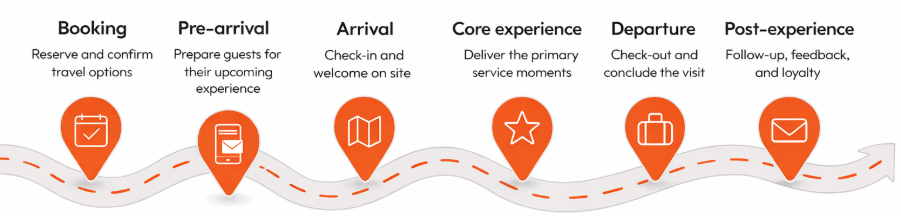
1. Booking
This is the guest's first real interaction with your brand. Whether they book a hotel room through your website, buy a train ticket on an app, reserve a table by phone, purchase attraction tickets through a third-party platform, or book a flight through an Online travel agent (OTA), this moment shapes their expectations for everything that follows.
Feedback here tells you whether the booking process is clear, easy, and confidence-building, or whether guests are encountering confusion, friction, or doubt. This applies across every sub-sector, because every sub-sector has a booking or purchasing step that can go well or badly.
2. Pre-arrival
The period between booking and the experience is often overlooked, but it matters. What this stage looks like varies considerably:
- Hotels: Confirmation emails, pre-arrival information, check-in instructions, requests for preferences
- Airlines: Boarding passes, seat selection prompts, baggage information, travel updates, disruption alerts
- Train operators: Journey planners, real-time disruption alerts, platform information
- Attractions: Directions, opening times, suggested itineraries, event schedules
- Restaurants: Confirmation messages, menu previews, dietary preference requests
- Cruise lines: Travel documents, excursion booking, app onboarding, embarkation information
Across all of these, the underlying purpose is the same: preparing the guest for the experience. Feedback here reveals whether your communications are helpful and reassuring or whether they're creating uncertainty. "Did my booking go through? What do I need to bring? Will there be queues? Is my train running on time?"
3. Arrival
First impressions are disproportionately powerful. What "arrival" means depends entirely on the business:
- Hotels: Check-in, room allocation, the welcome
- Airlines: Airport check-in, security, boarding, finding your seat
- Train operators: The station environment, finding the right platform, boarding
- Attractions and theme parks: The entrance experience, ticketing, bag checks, first impression of the venue
- Restaurants: The greeting, the wait for a table, being seated
- Cruise lines: Embarkation, cabin allocation, orientation
The details vary enormously, but the principle is the same across all of them: this is the moment that sets the tone for everything that follows. Feedback here captures the guest's emotional state at a point when it's often still possible to recover if something has gone wrong.
4. The core experience
This is the heart of the journey: the stay, the flight, the meal, the visit, the voyage. It's also the stage with the most variation, both across and within sub-sectors.
A hotel guest might interact with housekeeping, the restaurant, the spa, the concierge, and the front desk, all in a single day. An airline passenger's core experience is the flight itself: the seat, the cabin, the crew, the food, the entertainment. A theme park visitor moves through multiple attractions, dining venues, and retail outlets over several hours. A train passenger's experience centres on the journey itself: the carriage, the wifi, the catering, the punctuality. A restaurant guest's core experience is the meal: the food, the service, the pacing, the ambience.
One important distinction: for businesses with longer guest interactions (hotels, resorts, cruise lines), feedback during the core experience is uniquely valuable because it allows for real-time recovery. A guest who reports a problem on day one can have it resolved before day two. That changes the entire trajectory of their experience.
For shorter experiences (a single flight, a meal, a train journey, a day visit), collecting feedback during the core experience is harder and sometimes impractical. But it's not impossible. In-app prompts, QR codes at key touchpoints within the experience (on the tray table, at the exit of a ride, on the restaurant table), or post-interaction SMS can still capture in-the-moment feedback when it matters.
5. Departure
Departure is both a logistical moment and an emotional one. It's the last direct interaction you have with the guest, and it takes different forms across the sector:
- Hotels: Checkout, billing, farewell
- Airlines: Disembarkation, baggage collection, the arrival airport experience
- Train operators: Alighting, onward connections, exiting the station
- Attractions: The exit experience, the gift shop, the car park, getting home
- Restaurants: The bill, the farewell, leaving
- Cruise lines: Disembarkation, luggage collection, transfer
Whatever the setting, departure is often the freshest memory when guests sit down to write a review or respond to a survey. A billing error at checkout, a lost bag at the carousel, a long wait for the bill, or a chaotic disembarkation process can undo goodwill built during an otherwise excellent experience.
6. Post-experience
This is where most organisations already collect feedback, and it still matters. Post-experience surveys capture the guest's overall impression, their likelihood to return or recommend, and their broader reflections. They're also the right moment to ask about intent: would you fly with us again? Would you stay again? Would you visit again? What would bring you back?
The difference is that when post-experience feedback sits alongside data from earlier stages, it becomes far more useful. You can see whether a low overall score connects to a specific stage and you know exactly where to focus your improvement efforts.
How the stages look across different businesses
The six-stage framework is deliberately broad. Here's a quick view of how it maps to some common travel and hospitality contexts. This isn't exhaustive, as every business is different, but it illustrates how the same structure applies even when the details change significantly.
You don't need to collect feedback at every stage from day one. The table is a map of opportunities, not a minimum requirement. Start with the stages that matter most to your business and expand from there.
Adapting for journey length
One of the most important differences across travel and hospitality sub-sectors is how long the guest experience lasts. This directly affects how you apply multi-stage feedback.
Longer experiences (multi-night hotel stays, cruises, resort holidays): These are ideal for multi-stage feedback. There's time between stages for the guest to respond, and there are natural pauses in the experience (arriving back at the room, a quiet evening, a sea day) where feedback requests feel unobtrusive. You also have the greatest opportunity for real-time recovery, where collecting feedback during the stay is both practical and highly valuable.
Medium-length experiences (day visits to attractions, day trips, conference attendance): These have clear stages but compressed timelines. You probably won't survey during the experience itself (nobody wants to pause mid-theme-park for a survey), but you can capture feedback at entry, at exit, and post-visit. QR codes at exit points are particularly effective here because the experience is fresh and the visitor has a natural pause.
Short experiences (a single flight, a train journey, a meal): These compress the entire journey into hours or less. Multi-stage feedback in the traditional sense doesn't apply. Instead, focus on two well-chosen moments: one at or near the point of experience (an in-app prompt after landing, a QR code on the receipt, a post-journey SMS) and one reflective follow-up (a post-experience email the next day). For very short experiences, a single well-timed survey is often all you need.
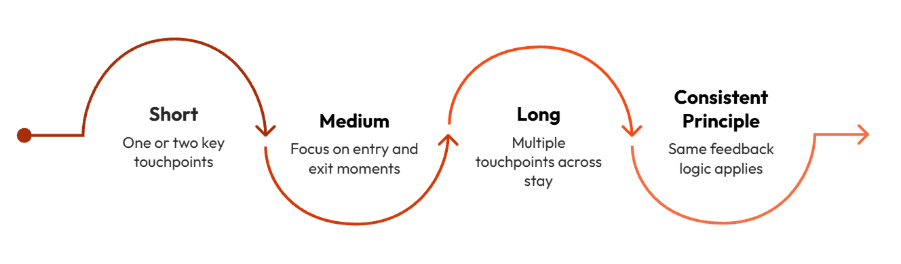
The principle stays the same regardless of duration: ask the right question, at the right moment, through the right channel. What changes is how many "right moments" you have and how you space them out.
What to ask at each stage
Matching the right question to the right moment is what makes multi-stage feedback work. The goal is to keep each survey short (ideally one to three questions) and specific to the experience the guest just had.
The table below uses broadly applicable language. Swap in the terms that fit your context: "arrival" might be "check-in," "boarding," "entrance," or "embarkation" depending on your business.
A few things to notice. The metric changes to match the moment. CES (effort) makes sense for process-heavy stages like booking. CSAT (satisfaction) fits experience-based stages like arrival and the core experience. NPS (recommendation) works best at the relationship level, after the full experience is complete.
The channel matches the context. You wouldn't email a guest during check-in or mid-flight. A QR code, in-app prompt, or SMS is far more natural in those moments. A post-experience email makes more sense for a longer, reflective survey.
Every survey is triggered by a specific event, not sent on a schedule. This is what keeps feedback timely and relevant.
How to avoid survey fatigue
The obvious concern with collecting feedback at multiple stages is over-surveying. If a hotel guest receives six surveys during a three-night stay, that's a problem. But multi-stage feedback doesn't mean surveying at every stage for every guest.
Here are three practical approaches to keep volume in check.
Timeline
Time it to capture the moment that matters. You don’t need feedback at every stage focus on the moments that most shape the experience (check-in, first meal, boarding, checkout, etc.). Place lightweight feedback prompts directly in the flow of the journey at the point of experience so guests can respond when it’s fresh. For shorter experiences (a single flight, a meal, a day visit), one well-timed touchpoint is usually enough. Save multi-stage collection for longer journeys where each stage genuinely adds new insight.
Keep surveys extremely short. A simple framework works well here: a single rating question, a neutral open-text follow-up, and a conditional third question only for dissatisfied respondents. Most guests can complete this in under 30 seconds. A survey that short feels less like a chore and more like a quick check-in.
Make it optional and unobtrusive. A QR code on a hotel bedside card, on an airline seat-back card, on a train tray table, at an attraction exit, or on a restaurant receipt is available to every guest but intrudes on nobody. An SMS after arrival is easy to ignore if the guest isn't in the mood. The key is to make feedback opportunities available at the right moments without making them feel mandatory or disruptive.
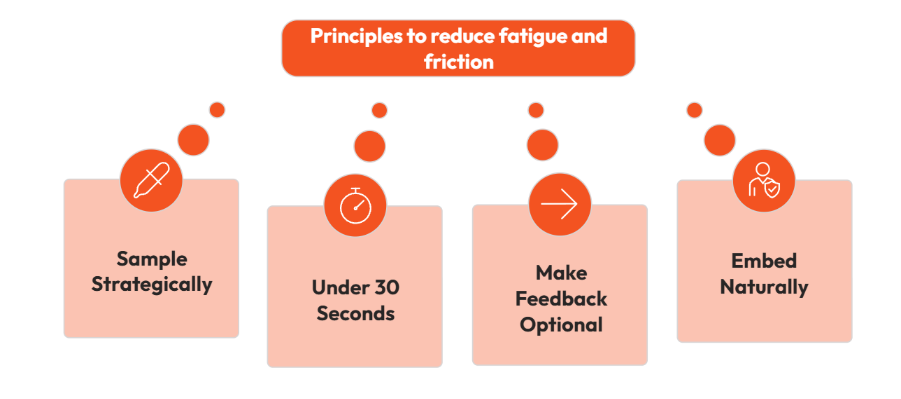
The principle behind all of this is embedding feedback into the experience rather than interrupting it. When a feedback prompt sits naturally within the guest's environment, it feels like part of the service, not an imposition.
Making it work at scale with triggers and automation
Collecting feedback at multiple stages only works if it's automated. You can't manually send a survey every time a guest checks in, a flight lands, or a table turns over. Instead, you define triggers: specific events or actions that automatically prompt a feedback request.
For digital touchpoints (booking, pre-arrival communications, post-experience), this typically means connecting your survey platform to your property management system, reservation system, airline operations system, or CRM. When a booking is confirmed, the post-booking survey fires. When a guest checks out or a flight lands, the post-experience email is scheduled. No manual step required.
For physical touchpoints (arrival, during the experience, departure), QR codes and kiosks provide always-on feedback collection without any integration at all. Print a QR code on a boarding pass, a hotel receipt, a restaurant bill, an attraction map, or a cruise ship daily programme. Guests scan when they want to, and responses flow into your feedback platform automatically.
If your tech stack supports it, integrations between your survey platform and your existing business systems let you automate triggers, pipe in contextual data (room type, flight number, route, location, booking channel) as hidden fields, and route responses to the right teams without manual effort.
Getting started: pick one gap and fill it
You don't need to build a six-stage feedback programme overnight. Most organisations already have post-experience feedback in place. The highest-impact next step is to pick one additional stage where you currently collect nothing and add a short, focused survey there.
Where that gap is depends on your business:
- Hotels and resorts: Often the biggest gap is during the stay, where real-time recovery is possible and problems can be fixed before they become reviews.
- Airlines: The boarding and arrival experience frequently goes unmeasured despite its outsized impact on satisfaction. The post-flight moment (immediately after landing, before the passenger leaves the airport) is also often missed.
- Train operators: The on-board experience and the station departure experience are common gaps. Punctuality data exists operationally, but passenger experience data at these stages often doesn't.
- Restaurants: The arrival experience (greeting, wait time, seating) is frequently missed despite being the moment that shapes first impressions.
- Attractions and venues: The exit point is commonly overlooked, despite being the moment when the experience is freshest and the visitor has a natural pause.
- Cruise lines: Individual touchpoints within the voyage (dining, excursions, entertainment) often go unmeasured, even when overall voyage feedback is collected.
Whatever your context, the approach is the same: choose the stage with the biggest coverage gap and the most business impact, design a short survey for that specific moment, and deploy it through the channel that fits. Once it's working, expand to another stage. Over time, you'll build a feedback programme that covers the full guest journey, with each stage providing a different lens on the experience.
Making it work at scale with triggers and automation
Collecting feedback at multiple stages only works if it's automated. You can't manually send a survey every time a guest checks in, a flight lands, or a table turns over. Instead, you define triggers: specific events or actions that automatically prompt a feedback request.
For digital touchpoints (booking, pre-arrival communications, post-experience), this typically means connecting your survey platform to your property management system, reservation system, airline operations system, or CRM. When a booking is confirmed, the post-booking survey fires. When a guest checks out or a flight lands, the post-experience email is scheduled. No manual step required.
For physical touchpoints (arrival, during the experience, departure), QR codes and kiosks provide always-on feedback collection without any integration at all. Print a QR code on a boarding pass, a hotel receipt, a restaurant bill, an attraction map, or a cruise ship daily programme. Guests scan when they want to, and responses flow into your feedback platform automatically.
If your tech stack supports it, integrations between your survey platform and your existing business systems let you automate triggers, pipe in contextual data (room type, flight number, route, location, booking channel) as hidden fields, and route responses to the right teams without manual effort.
Getting started: pick one gap and fill it
You don't need to build a six-stage feedback programme overnight. Most organisations already have post-experience feedback in place. The highest-impact next step is to pick one additional stage where you currently collect nothing and add a short, focused survey there.
Where that gap is depends on your business:
- Hotels and resorts: Often the biggest gap is during the stay, where real-time recovery is possible and problems can be fixed before they become reviews.
- Airlines: The boarding and arrival experience frequently goes unmeasured despite its outsized impact on satisfaction. The post-flight moment (immediately after landing, before the passenger leaves the airport) is also often missed.
- Train operators: The on-board experience and the station departure experience are common gaps. Punctuality data exists operationally, but passenger experience data at these stages often doesn't.
- Restaurants: The arrival experience (greeting, wait time, seating) is frequently missed despite being the moment that shapes first impressions.
- Attractions and venues: The exit point is commonly overlooked, despite being the moment when the experience is freshest and the visitor has a natural pause.
- Cruise lines: Individual touchpoints within the voyage (dining, excursions, entertainment) often go unmeasured, even when overall voyage feedback is collected.
Whatever your context, the approach is the same: choose the stage with the biggest coverage gap and the most business impact, design a short survey for that specific moment, and deploy it through the channel that fits. Once it's working, expand to another stage. Over time, you'll build a feedback programme that covers the full guest journey, with each stage providing a different lens on the experience.


Neil has a deep understanding of software and how to bring its value to market. With experience across Human Capital Management, Learning & Development, AI-powered platforms and omnichannel communications, he knows what it takes to connect solutions with real business needs. Neil’s passionate about helping organisations turn insight into action and elevate the customer experience.


