

What guests really value: Use feedback to find and repeat your standout moments

Key highlights
Most guest feedback programmes focus almost entirely on what went wrong. Complaints get escalated, low scores get investigated, and improvement plans target the weakest areas. That's important work, but it only tells half the story. Understanding what guests love, and why, is equally valuable because it shows you what to protect, replicate, and build on.
What you'll learn in this post:
- Why most feedback programmes over-index on negative feedback and what that costs you
- How to systematically identify "bright spots" in your guest experience using feedback data
- What standout moments typically look like across different sub-sectors (hotels, airlines, train operators, attractions, restaurants)
- How to segment positive feedback by guest type, season, and location to understand what different audiences value
- A practical framework for turning positive insights into repeatable operational actions
- Why reinforcing strengths is often a faster path to better reviews than fixing weaknesses
The negativity trap in guest feedback
There's a natural gravitational pull towards negative feedback. It feels urgent. A complaint about a dirty room, a delayed flight, a cold meal, or a broken ride demands attention. A compliment about a lovely welcome, a helpful cabin crew member, a punctual service, or a beautifully presented dish feels nice but doesn't trigger action.
This creates an asymmetry in how most organisations use feedback. Negative data gets analysed, escalated, discussed in meetings, and turned into action plans. Positive data gets acknowledged ("Great, guests like the pool," or "Passengers are happy with the app," or "Visitors loved the new exhibit") and then largely ignored.
The problem with this approach is that it tells you what to fix but not what to amplify. You end up spending all your energy plugging gaps while your genuine strengths go unexamined and unreplicated. Worse, you might inadvertently change something guests love because nobody flagged it as important.
Consider what happens when positive insights stay buried. A hotel group discovers that guests consistently praise the personalised welcome notes left by housekeeping at one property, but the practice never spreads to other sites. An airline finds that passengers frequently mention a specific crew greeting routine that makes them feel valued, but it stays with one base's team. A theme park learns that families consistently highlight one staff member's storytelling at a particular attraction, but nobody captures what makes that storytelling work. A train operator's passengers regularly praise the real-time journey updates on a particular route, but the communication style isn't adopted network-wide.
In every case, data that could improve the experience across the entire operation sits unused because the feedback programme is wired to focus on problems.
What standout moments look like across the sector
Before diving into how to identify bright spots, it's worth acknowledging that what guests value, and what creates memorable moments, varies significantly across travel and hospitality sub-sectors. The analytical process is the same, but what you're looking for is different.
This matters because if you're looking for bright spots in your feedback, you need to know what kind of things to pay attention to. A hotel's standout moments are often about personal interactions. An airline's are often about reliability and crew attitude. A theme park's are often about emotional peaks. Your analysis should be tuned to the types of moments that matter most in your specific context.
How to identify what guests value most
Identifying bright spots requires the same analytical rigour you apply to complaints, just pointed in the other direction. Here's how to approach it.
Start with your open-text responses
Rating scores tell you how satisfied guests are. Open-text responses tell you why. And the "why" behind high scores is where your most actionable positive insights live.
When an airline passenger rates their flight 5 out of 5 and writes "The crew noticed I was nervous and checked on me twice during the flight," that's not just a nice comment. It's data. When a hotel guest writes "The staff remembered my name and my room preference from last year," that's data too. When a restaurant diner writes "Our waiter recommended a wine pairing that made the whole meal," that's data. Each tells you that a specific behaviour or practice created a memorable moment for that guest, and likely would for others like them.
If you're collecting feedback using a neutral open-text prompt (something like "Please give us your feedback on your experience" rather than a leading question like "What did you enjoy?"), your positive responses will be genuine and unprompted. That makes them especially valuable because the guest chose to mention it without being steered.
Use AI to surface themes at scale
Reading individual comments is useful for small volumes, but most travel and hospitality organisations generate far more feedback than any person can read. This is where AI-powered thematic analysis becomes essential.
Sentiment analysis tools can process thousands of open-text responses and identify recurring positive themes automatically. Instead of reading 500 comments, you can see ranked results that tell you what guests value most, based on what they voluntarily chose to mention.
What the top themes look like depends on your business. For a hotel, the top three might be "staff friendliness," "room cleanliness," and "breakfast quality." For an airline, "crew professionalism," "seat comfort," and "on-time performance." For a train operator, "punctuality," "carriage cleanliness," and "easy booking." For a theme park, "ride experience," "atmosphere," and "staff enthusiasm."
The important thing is to look at positive themes with the same seriousness you give to negative ones. If "crew professionalism" or "staff friendliness" is your top positive driver, that's not just good news. It's a strategic asset you need to understand, protect, and scale.
Compare what drives praise versus what drives complaints
One of the most revealing analyses you can run is a side-by-side comparison of your top positive themes and your top negative themes. Often, they're not mirror images of each other.
A hotel might find that its top complaints relate to wifi speed, parking, and noise, while its top compliments relate to staff warmth, food quality, and the view. An airline might see complaints about legroom, delays, and baggage handling alongside praise for crew attentiveness and the booking app. A theme park might receive complaints about queue times and pricing alongside praise for the atmosphere and specific rides. A train operator might see complaints about overcrowding and delays alongside praise for the quiet carriage and onboard catering.
This tells you something important: the things that delight guests and the things that frustrate them are often entirely different aspects of the experience. Fixing the wifi won't generate the kind of praise that staff warmth does. Improving legroom won't produce the same emotional response as a genuinely caring crew. Reducing queue times won't create the kind of buzz that a brilliant new attraction does.
You need to address both, but treating them as separate workstreams stops you from assuming that fixing everything negative will automatically make the experience positive. It won't. Removing frustration and creating delight are different kinds of work.
Segment by guest type, season, and location
Not all guests value the same things. Segmenting your positive feedback reveals differences that help you tailor your approach rather than treating all guests as one group.
By guest or passenger type
If your feedback data includes guest or passenger type (business, leisure, family, couple, solo, frequent versus infrequent), filter your positive themes by segment.
The findings will be specific to your business, but common patterns include: business travellers and frequent flyers tend to disproportionately praise speed, efficiency, and reliability. Families highlight flexibility, friendliness, and activities or entertainment. Solo travellers often value personalised attention and ease of navigation. Couples mention atmosphere, food quality, and privacy. First-time visitors to an attraction notice different things from regular visitors, who may be more attuned to changes or new additions.
These aren't always surprising findings, but having the data lets you invest with confidence rather than assumption. And occasionally the data will surprise you, revealing that a segment values something you hadn't prioritised for them.
If you're piping contextual data into your surveys as hidden fields (booking type, loyalty tier, party size, fare class, ticket type), this segmentation happens automatically. You don't need to ask guests to categorise themselves. Use the data you already hold.
By season
Guest expectations shift with the calendar, and what drives praise shifts with them. A hotel that gets praised for its outdoor terrace in summer may hear nothing about it in winter. A ski resort that gets glowing feedback on slope conditions in January may face complaints about limited activities in the off-season. An airline that gets positive comments about smooth operations in summer might see satisfaction dip during the disruption-heavy winter months. An outdoor attraction that earns praise for its gardens in spring may struggle with weather-related complaints in autumn.
Tracking positive themes over time reveals what's driving satisfaction in each period. This helps you plan seasonal adjustments: which experiences to promote, which to invest in, and which temporary offerings (a seasonal menu, a pop-up activity, an event programme, a themed in-flight experience, a winter light trail) are worth repeating because the feedback data shows they work.
By location, route, or venue
For multi-site operators, comparing positive themes across locations, routes, or venues is one of the most useful things you can do with feedback data. It surfaces practices and experiences that are working at individual sites but haven't been shared across the group.
If one hotel consistently gets praised for its turndown service and another for its restaurant recommendations, those insights are portable. If one route's cabin crew gets consistently higher praise than another, find out what they're doing differently. If one branch of a restaurant chain is outperforming the others on atmosphere, document why. If visitors to one theme park site rate the staff more highly than another, investigate the training or culture differences.
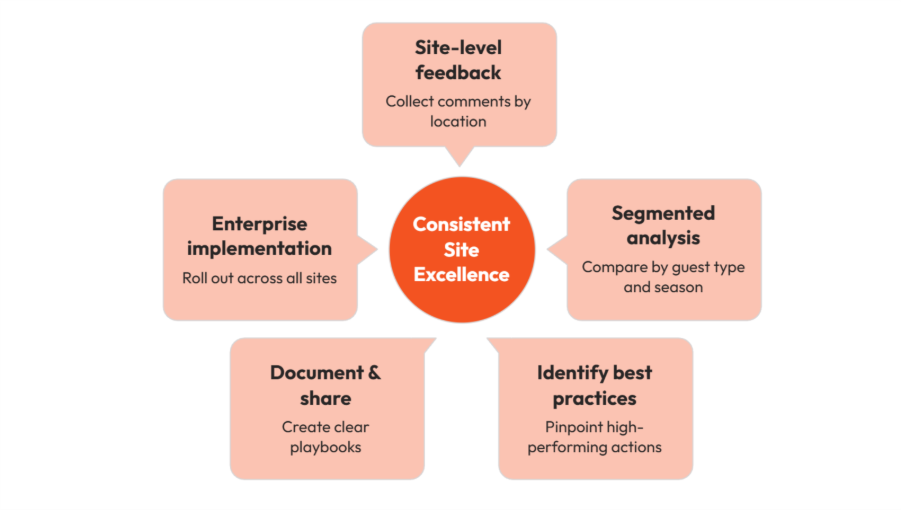
The practices behind these bright spots can be understood, shared, and adopted by other properties, routes, or venues. Without this analysis, best practices stay siloed and the guest experience varies more than it needs to across your operation.
Turn positive insights into repeatable actions
Identifying what guests value is the analytical step. The next step is making sure those insights lead to deliberate, repeatable operational actions, not just warm feelings in a quarterly report.
Document what's driving the praise
When you identify a strong positive theme, dig into the operational detail behind it. The specifics matter because they're what you'll replicate.
If guests consistently praise the arrival experience at a particular hotel, find out what that team is doing differently. Is it a specific greeting approach? A process that avoids queues? A small gesture like offering a drink on arrival? If passengers praise a particular route's crew, what's different about their briefing, their training, or their culture? If one restaurant location consistently gets higher food scores, is it the chef, the suppliers, the menu design, or the plating? If one attraction venue gets standout reviews for its staff, what does their onboarding or team culture look like?
The details are everything. "Staff are great" isn't actionable. "Staff greet guests by name, offer to carry bags, and proactively recommend local restaurants during check-in" is.
Share insights with front-line teams
Feedback insights are wasted if they stay in a dashboard that only the CX team sees. Front-line staff, the people who actually deliver the experience (reception teams, cabin crew, ride operators, waiters, station staff, tour guides), need to know what guests value most.
This doesn't mean overwhelming teams with data. It means sharing two things regularly: what guests are praising (so teams know what to keep doing and feel recognised for it) and specific examples of standout moments (so teams understand what "great" looks like in practice, not just in theory).
A short weekly summary, highlighting the top positive theme and one or two guest quotes, is more effective than a monthly report with 30 charts. Keep it simple, keep it frequent, and keep it focused on what teams can actually influence.
Build positive practices into training and standards
Once you've identified and documented what drives guest delight, embed it. If personalised welcome notes drive praise at one hotel, introduce the practice across the group with guidance on how to do it well. If a particular boarding approach gets consistently positive feedback, incorporate it into crew training. If one restaurant location's table-side manner is generating standout reviews, make it part of the onboarding for new staff. If one theme park team's energy is driving praise, capture what they do in pre-shift briefings and share it with other venues.
The goal is to move bright spots from being individual habits into being organisational standards. Not by creating rigid scripts, but by giving teams clear guidance on the behaviours and practices that guests value most, backed by real feedback data.
Why reinforcing strengths often beats fixing weaknesses
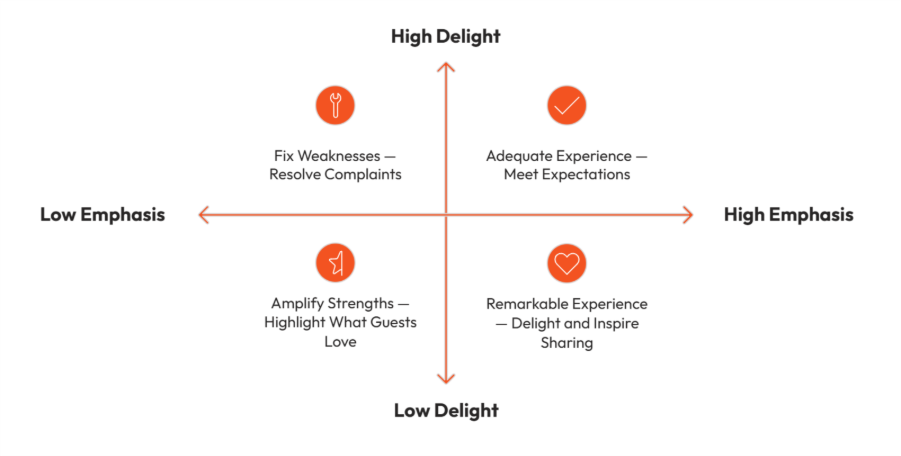
There's a practical reason to invest in understanding what guests love, not just what they complain about. In many cases, amplifying a strength has a faster and more visible impact on review scores, repeat bookings, and word-of-mouth than fixing a mid-level weakness.
A hotel that's already competent at most things but exceptional at one (food, service warmth, location guidance) often benefits more from leaning into that differentiator than from chasing perfection on everything else. An airline known for outstanding crew service gains more from celebrating and reinforcing that reputation than from marginal improvements to seat pitch. A theme park known for its atmosphere and theming benefits from doubling down on immersion rather than only trying to reduce queue times. Guests remember and talk about what was remarkable, not what was merely adequate.
That doesn't mean ignoring complaints. It means running both workstreams in parallel: fixing the things that cause friction and investing in the things that create delight. Your feedback data, properly analysed, tells you where to do each.
Getting started
If your feedback programme currently focuses on problems, here's a practical starting point for shifting the balance.
- Run a positive theme analysis. Take your last quarter of open-text feedback, filter for responses linked to high satisfaction scores, and identify the three to five most common positive themes. If you're using AI-powered analysis, this takes minutes rather than hours.
- Pick one bright spot to investigate. Choose the positive theme that surprised you most or that has the most potential to be replicated across your operation. Dig into the operational detail: what's happening behind the scenes to create this experience?
- Share it with one team. Take your finding to the front-line team responsible and discuss how to protect, strengthen, or scale it. Keep the conversation practical: "Guests consistently praise X. How do we make sure it keeps happening, and can we extend it to other [properties / routes / venues / locations]?"
Over time, build this into a regular rhythm alongside your complaint analysis. The organisations that consistently deliver standout guest experiences aren't just good at fixing problems. They're deliberate about understanding and replicating what guests love.


Neil has a deep understanding of software and how to bring its value to market. With experience across Human Capital Management, Learning & Development, AI-powered platforms and omnichannel communications, he knows what it takes to connect solutions with real business needs. Neil’s passionate about helping organisations turn insight into action and elevate the customer experience.


